

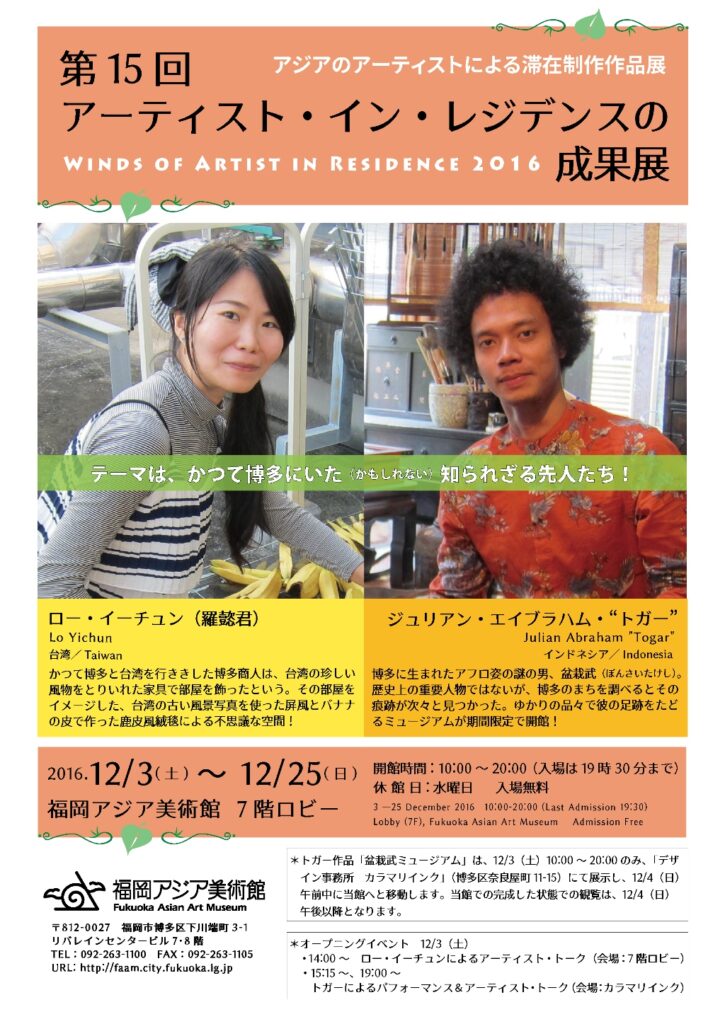
WINDS OF ARTIST IN RESIDENCE 2016
- Period
- Dec 3, 2016 〜 Dec 25, 2016
- Venue
Museum Lobby (7F)
The Fukuoka Asian Art Museum Artist in Residence Program invites emerging artists from Asian countries and regions to Fukuoka to promote diverse artistic and cultural exchange through collaborative art-making and workshops. We are pleased to present the exhibition of the two artists, Lo Yi Chun from Taiwan and Julian Abraham “Togar,” from Indonesia, invited to join the residence program this year.
Lo Yi Chun (羅懿君) [Taiwan]
Inspired by the story of a Hakata merchant who engaged in trading between Hakata and Taiwan, Yi Chun created an installation piece in the style of Japanese Byobu folding screens and a deerskin rug made entirely of banana peels.
Artist Statement
“Tropical Collection” consists of twelve landscapes of Taiwan where the most crops and natural resources in Taiwan trading history were exported, along with a piece of deerskin-patterned rug made from banana peels.
For this series, I was interested in international trade and sought out the content behind it. Recognizing that Hakata port played an important role in Japan’s maritime history, I visited the descendants of a Hakata merchant who had owned a ship and sailed to various Asian countries. I made up a story about the merchant’ s journey to Taiwan by 12 pieces of photo collages. The photos are originally from different historical archives of the early 20th century, but are turned into new pieces of sceneries in my installation. Through the gesture of collecting and collaging existing document, the work shows the distorted landscapes, questions the line between fiction and reality, and opens up other ways of interpretation.
During my residency at FAAM, I was inspired by Japanese “Byobu” folding screens and tried to connect the geographical characters of landscape into geometrical forms so as to explore the boundaries between sculpture, furniture and installation.
Julian Abraham “Togar” [Indonesia]
A mysterious, Hakata-born figure named Takeshi Bonsai is distinguished by his trademark Afro hairstyle. Despite being a minor figure in history, vestiges of the man emerged as we explored the city of Hakata. Inside a temporary museum, visitors are invited to look for his footsteps through a number of references.
Artist Statement
Museum of Takeshi Bonsai
My initial proposal for the residency program was to make a monument. Like many monuments, it should be designed to convey historical information from a particular society or a specific region. Monuments preserve the historical information of the site, and become a landmark for a certain historical event. In another way, it is also a cultural statement. But unlike many monuments, my idea of monument-making is not about making any physical forms. A monument can be manifested in the form of activities or events.
When I arrived in Fukuoka, I started looking for something that needed to be preserved in some way. After a very short while, however, I realized that I couldn’t find one. The more time I spent, the more I realized that it was I who was actually learning about preservation here. Generally speaking, I think Japanese culture is very good at preserving both things and events. It is beyond any concept I have ever learned about preserving. Preservation in the Japanese culture as I have experienced and observed it is so fluid that it is almost like a living thing. Andnow, if someone wanted to study about natural preservation, I would definitely suggest coming to Japan.
I have therefore used this opportunity to come and stay in Fukuoka to deepen my knowledge about preservation. At the same time, I have tried to preserve my own learning experience by creating a Japanese character named Takeshi Bonsai. I have described the existence of Takeshi Bonsai through a series of visual presentations and made a museum dedicated to him. A museum is the utmost tribute one can imagine to the existence of one thing, place, person or event and to the importance of its being acknowledged and remembered by people. The Takeshi Bonsai stories were developed during my stay in Fukuoka through my day-to-day activities, interactions and conversations with people, through attending festivals and events, and by visiting various places around Fukuoka. These stories are as real to me as my experiences in encountering people, places and time.
In the process of making the museum, I collaborated with many different individuals. Most of them are artists. I wanted to use the museum as a platform for artists to work together, be it with other artists or with anyone else, to create better structures, and thus create better stories. The process of working with other people in making the Museum of Takeshi Bonsai is also a process of looking for affirmation from others, to get acknowledgment, acceptance, and confirmation of the existence of Takeshi Bonsai. By working with others, it also means that I want to develop a relationship, a bond that I hope can continue as long as possible.
Date: December 3 – December 25, 2016
Venue: Museum Lobby (7F), Fukuoka Asian Art Museum
On December 3, between 10:00am and 8:00PM, Bonsai Takeshi Museum by Togar will be displayed in Calamari Inc. (design studio) and will move to FAAM next morning on December 4. The work as a completed piece will be on view from the afternoon of December 4.
| Venue | Museum Lobby (7F) |
|---|---|
| Admission | Free |
| Organiser | Fukuoka Asian Art Museum |


