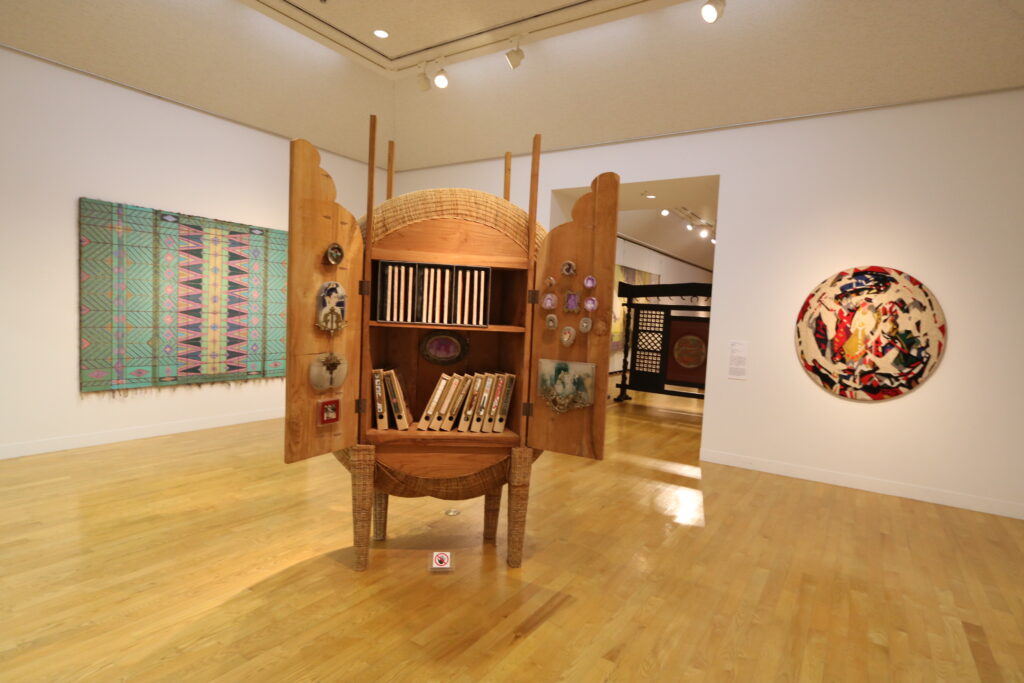

Hand Thinks
- Period
- Oct 4, 2018 〜 Jan 15, 2019
- Venue
Asia Gallery
The term ‘art production method’ may largely suggest painting, but the human hand is capable of much more.
There are various techniques and methods of expression such as sewing, dyeing, kneading, carving. Those who make the work with their hands communicate with various materials and intuitively find a way to create a beautiful outcome.
This exhibition introduces the Fukuoka Asian Art Museum’s collection in the following three sections.
1. Hand-works by women and men—Sewing, knitting, and drawing
2. Conversation with the inner world—Dyeing, kneading, engraving, and carving
3. Weave society—Knitting and weaving
Hand-works by women and men—Sewing, knitting, and drawing
Golden Bengal created in 2000 vividly depicts the life in Bengal where the artist lives. Embroidery depicts various people including men harvesting rice, women cooking fish or grounding spices as well as Rickshaws and bullock carts passing by the street. We can also see different roles women and men play in the community.
This embroidery tapestry called kanta is made by women’s hand. It was believed that kanta was strictly a female work although we now find a male designer in the commercial kanta developed after the 1980s. The situation was similar in Mongolian applique during the socialist era. In the work Happiness created in the 1970s, painter husband draws the pattern and his wife did the embroidery. In every country, braiding yarn was considered as a female job.
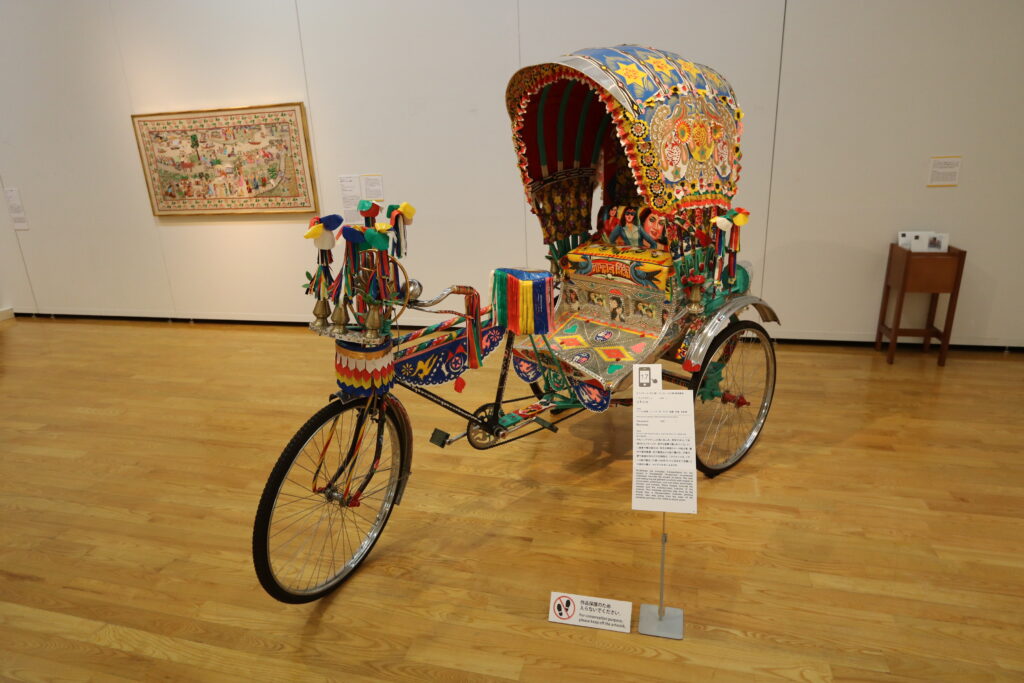
On the other hand, men traditionally dealt with the works related to vehicles. For instance, multiple divisions in rikshaw production such as body making, painted plate making, and decoration, are all occupied by the male craftsperson.
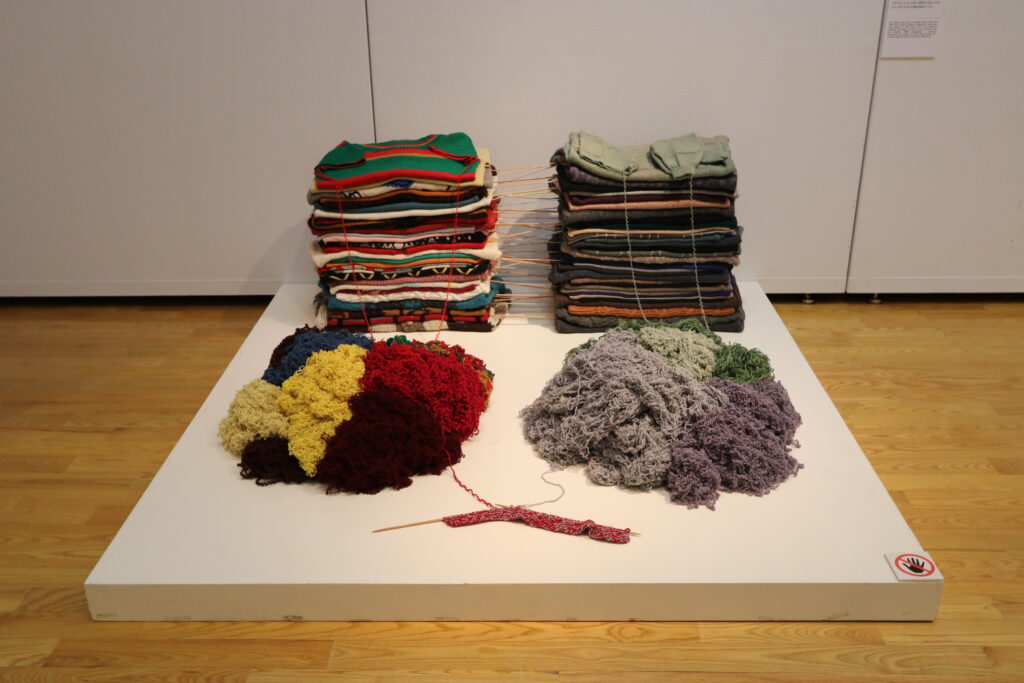
However, socially imposed gender role has been changed in contemporary urban life formed by the capitalistic economy. Woolen Yarn created by a female artist born in Beijing seeks to re-weave something using the yarn taken from male and female sweaters. As this work symbolizes, the contemporary world has produced various forms of expression that questions the traditional value system.
①Bengal region
Bengal region spreads in the fertile delta in the downstream of the Ganges. The area is divided into West Bengal, India where the majority of the population is Hindu, and Bangladesh where Muslim lives. Two zones that were culturally and politically bound, was divided due to the 1905 Partition of Bengal by the British colonial government.
②Nakshi Kantha
In the Bengal region, old sarees are often reused as a blanket by stitching the layers of saree together like a quilt. Such a knowledge has been handed down from mother to her daughter. In Bangladesh, NGO and other institutions have supported such handmade products as a means to improve women’s living conditions. Nakshi means pattern and Kantha quilt.
③Rickshaw
As the name shows, rickshaw was originated from Japanese rikisha (two-wheeled passenger vehicle drawn by one person). As a popular export good during the Meiji era (1868-1912), rikisha was shipped not only to Asia, but as far as to Africa, and changed its form according to the culture of the area.
Conversation with the inner world—Dyeing, kneading, engraving, and carving
This section introduces the works made with various materials and techniques including dyed silk painting, terra-cotta sculpture, 3D paper cutouts, and a painting-combined screen. However, they also share a similarity when we look at the message each work seeks to conveys.
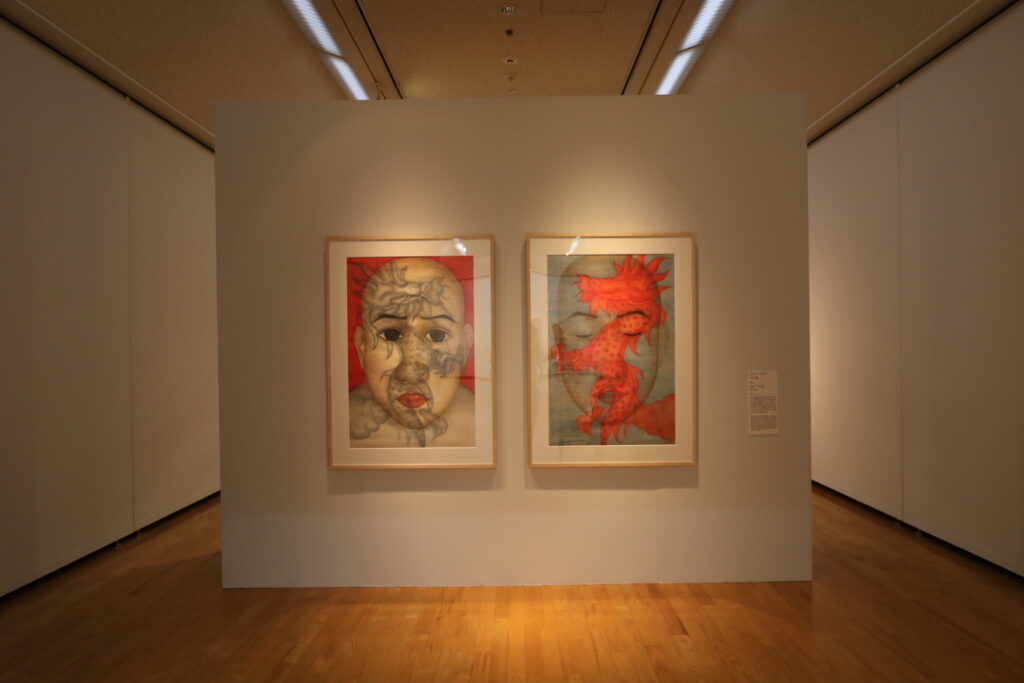
For instance, I’m a Dragon, a pair of two silk paintings from Vietnam depicts a dragon head and a human face. Although the person in the painting has no hair, it is a female, and the dragon on the other canvas symbolizes her inner energy. According to the artist, the internal power of the person heightens when facing the self in silence. It is inside of her quietly closing her eyes that a red dragon is growing as her internal energy grows. A deep color unique to silk painting that requires several washing processes matches to this tranquil piece.
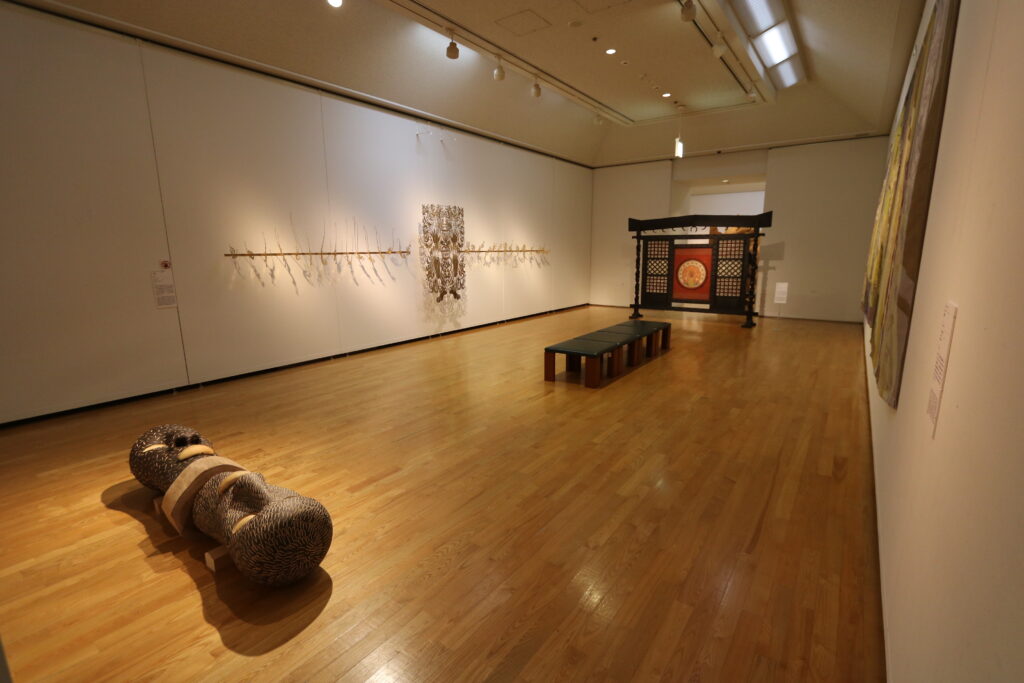
Other works like Windows of the Soul based on the animistic worldview of the mountain tribe, Starting from the Beginning V to indicate our essential ability to co-existent with nature, and Hands and Feet to describe the joy and gloom of human life, also make us see the inner world of human being.
Weave society—Knitting and weaving
Recently, there is a growing trend of the museum to directly engage with society and communities. Such trend includes the approach that initiates the inter-disciplinary co-creation and the project to solve social issues.
I Am Not That Kind of Particular Javanese is a mysterious work that appears to be a gigantic sculpture of traditional topknot called konde. Seeing from the back, we will find this work, in fact, is a very personal piece since it contains various things relating to his memory as well as his wedding photos. The artist sought to weave the idea and technique used in craft and the relationship with the artisans by collaborating with traditional wisteria ware artisans.
Rashid Choudhury, who created Golden Boat, founded Institute of Fine Arts in the University of Chittagong, claimed the importance of “art for society” and prioritize the use of local materials in art-making. He moved to Dhaka in his late life and built the tapestry factory to produce large-size tapestries of his design. Some say that he did so to start the industry that could sustain the life of workers.
| Venue | Asia Gallery |
|---|---|
| Admission | Adult \200 /College & High School \150 |
| Organiser | Fukuoka Asian Art Museum |
| Contact | Fukuoka Asian Art Museum / 092-263-1100 |