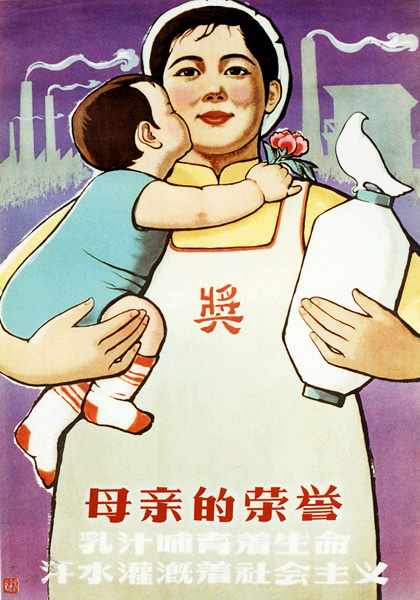
Ha Qiongwen, A mother's pride: milk nourishes life, sweat enriches socialism, 1958
Masterpieces from the FAAM Collection
- Period
- Mar 26, 2015 〜 Dec 25, 2015
- Venue
Asia Gallery
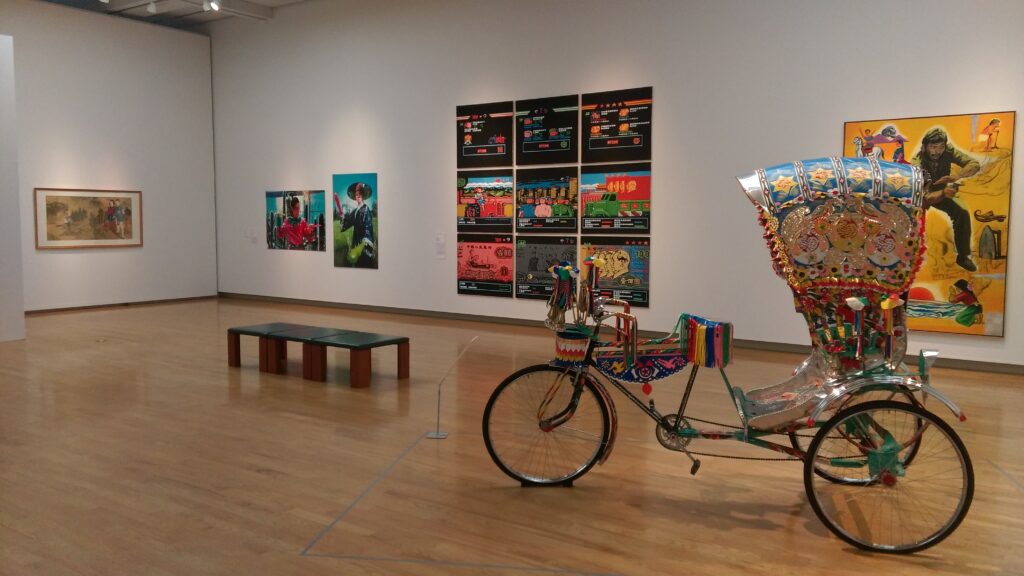
Kitsch Paradise
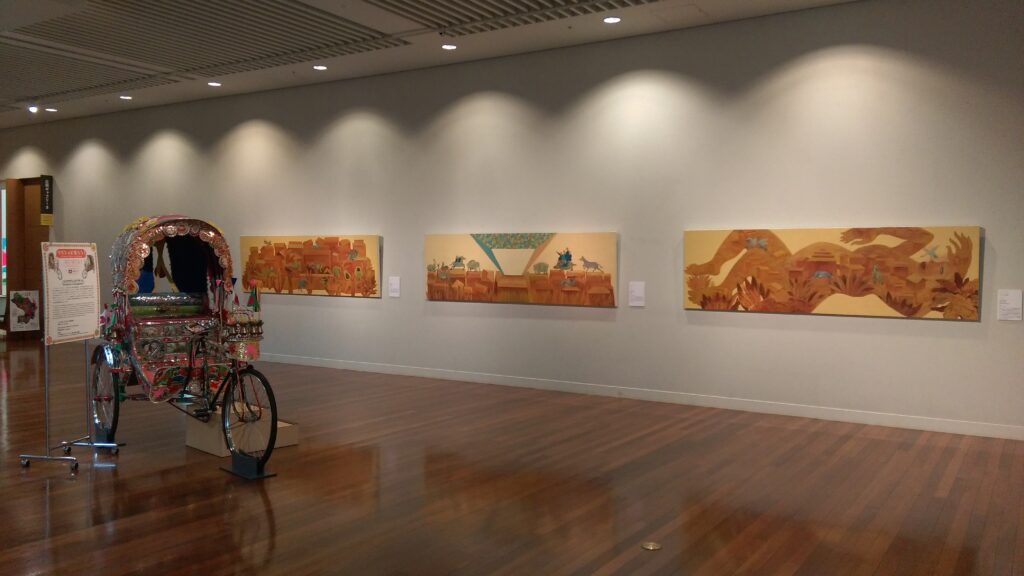
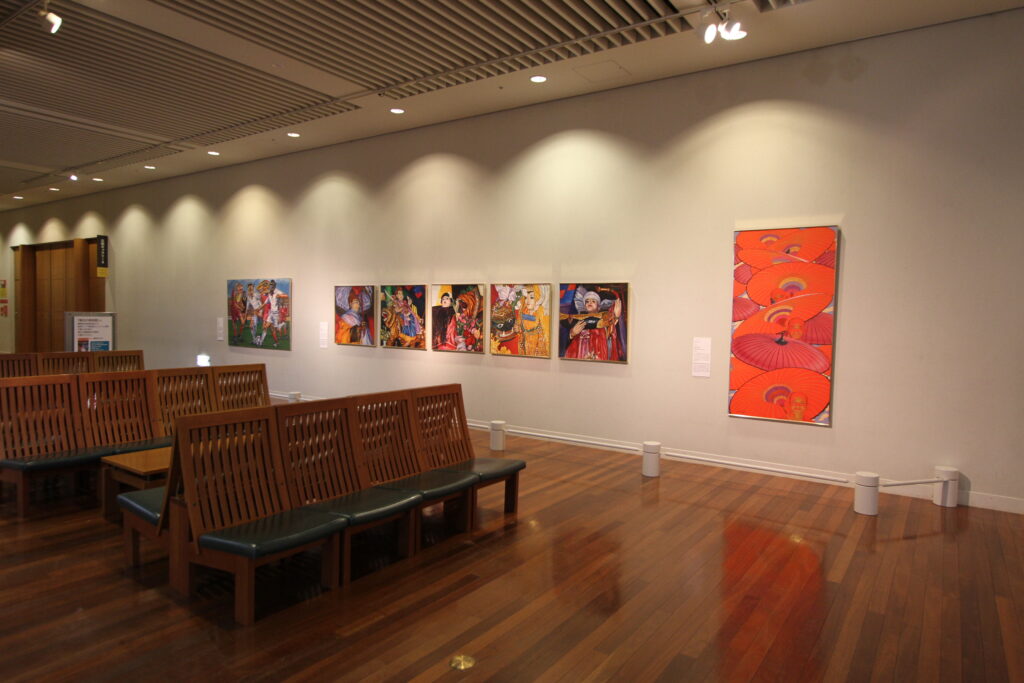
As a loanword from German, the term “kitsch” originally means “fake,” but it has become widely used as a concept seeking “gaudy,” “tawdry” or “cheap” aesthetic value in various art scenes around the world since the 1960s. In this part of the exhibition, expansive and uplifting artworks incorporating the “Kitschy” power arising from Asian popular culture are displayed.
Mother and Child
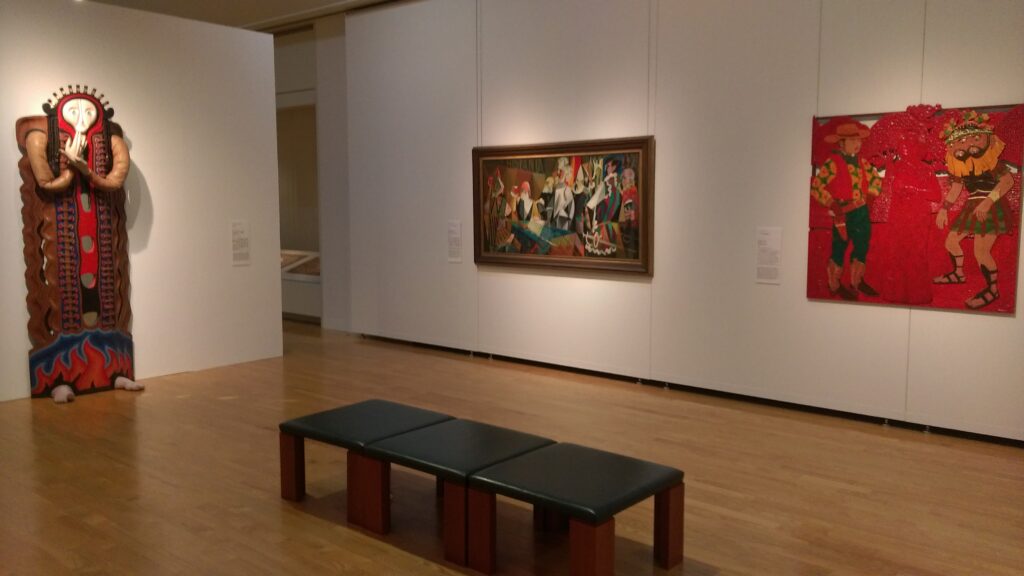
Love nurtured between a mother and a child. No love can be as strong as this, the most enduring bond between humans. There are many artworks that show “Mothers and Children” in the FAAM collection. In three sub-sections: “1: Hopes for Children,” “2: Absence of Mother, Absence of Child,” and “3: The Perfect Mother and Child,” this exhibition explores various depictions of “Mother and Child.”
Chinese New Year Painting
Numerous new-Nianhua (traditional auspicious prints made and distributed around the beginning of the New Year) posters were printed and distributed during the 1950s and early 60s, following the founding of the People’s Republic of China. The future visions of the nation and the ideal images of the people were presented with political slogans, which, as a whole, addressed various government policies visually. The style of new-Nianhua can be divided mainly into those which were offshoots of commercial posters from the 1920s and 30s (some of the artists overlap) and those executed in Yanan style which derived from the woodblock prints movement. The former group especially provides a clear and fine example of understanding the transition of popular visual culture in China through the shift from capitalism to socialism.
Modern Art in Asia
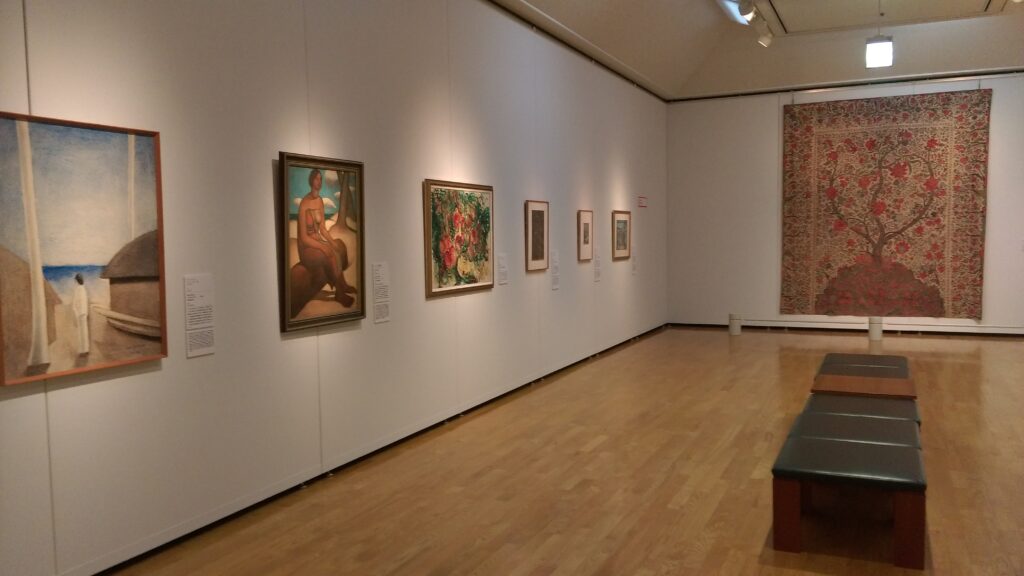
With the development of colonial economies by the Western countries after the 19th century, Western style paintings began to be created in Asian using Western painting materials and techniques to depict local people, customs, landscape, and myths. Such paintings were largely made for exporting and souvenirs for the West or for the local aristocrats. Therefore, these paintings reflect the exoticism by the Westerners of Asian countries.
However from the 20th century, with the rising nationalism and momentum towards gaining independence in Asian countries, many young artists worked towards creating modern art distinct to their countries. While many of the Asian modern artists were attracted to Western Impressionism, they tried to create original artworks incorporating their traditional expressions, indigenous subject matters and materials into their works.
“Tree of Life”
Indian calico was developed as a blend of Eastern and Western after the establishment of the East India Company (EIC) in the 17th Century. Responding to Western European demands, exotic designs were made in Europe and produced in India. Calico uses a batik wax-resist dying technique on cotton and designs commonly featured animals and birds etc. This calico is an example from this period and it integrates various design elements from India, China, Persia and Europe. The pattern in the center of the piece is modeled on the sacred fig tree; the “Tree of Life,” which was considered the source of all beings. Dendrolatry, the worship of tree exists in many parts of the world, and examples of this might be the tree in the story of the Garden of Eden in the Old Testament and the bodhi tree, the tree under which the Buddha was enlightened. With its design, indicative of active and rich imaginations, this Indian calico is colored by the “visions of Asia” that the Europeans held at that time.
Beginning from this piece, the “Tree of Life,” this part of the exhibition introduces two sub-sections: “1. Modern Art in India,” which focuses on the adoption of techniques and concepts from Western art in Asia after the 19th Century and “2. Attention Trees!,” which features the tree as a popular subject of landscape painting and still life painting.
Resonating Lines and Colors
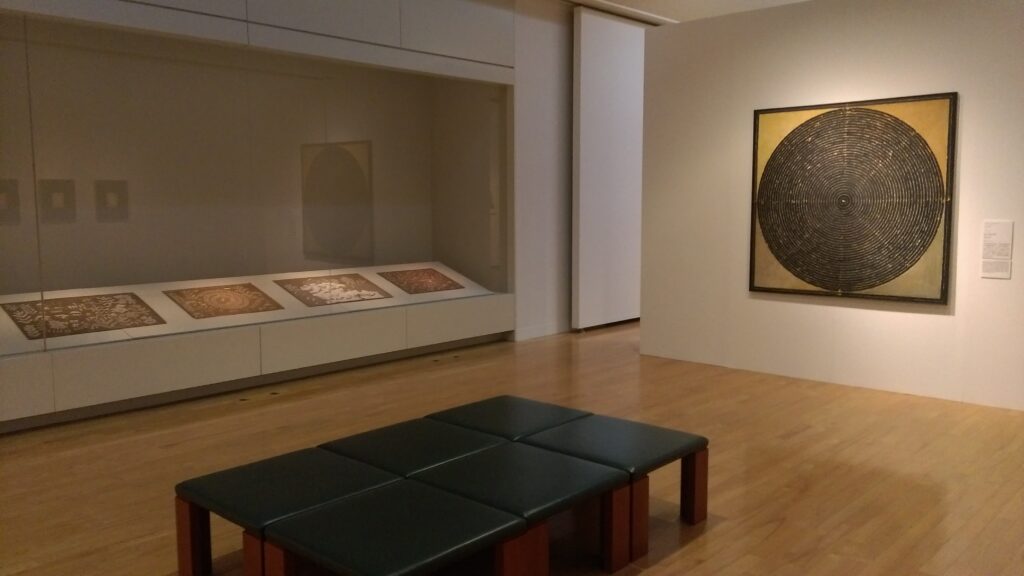
Tantras are esoteric scriptures that date back to the ancient India. Some Tantra scriptures are accompanied by paintings to illustrate the methods of meditation, and these are known as “Tantra Paintings.” On the other hand, “Warli painting” is a kind of rustic and simple folk painting created by the Warli people in India. The Warlis originally made drawings on walls, depicting village life and their cosmology; however, they have recently begun to make pictures for sale. Although both kinds of paintings are fascinating pictorial arts that are unique to India, the simple forms of the Tantra painting and the spiritual cosmology of the Tantras have been especially influential on Indian abstract fine art painters who take a uniquely Indian approach to their work. Syed Haider Raza’s “Kundalini” is characteristic of the attempts by such artists to create a new serene style of Tantra painting.
A Place Where East Meets West
Tseng Kwong Chi’s “East meets West” is a series of photographs, representative of the artist’s best work. Tseng is from Hong Kong, and he studied painting and photography in Paris. While taking souvenir pictures of European and American tourist spots and monuments in his ill-suited clothes, he considered encounters, such as his, between East and West. Covered with sunglasses, his face shows no hint of his psychological state.
All the works exhibited here reflect the artists’ ambivalent mental state: an inner struggle between the artists’ identity as an Asian and his encounter with the West as an overwhelming cultural and political force, a process where their inner-self is becoming intertwined with Western values.
Before 2015 Nepal Earthquake Wonderful Ordinary Days
Tseng Kwong Chi’s “East meets West” is a series of photographs, representative of the artist’s best work. Tseng is from Hong Kong, and he studied painting and photography in Paris. While taking souvenir pictures of European and American tourist spots and monuments in his ill-suited clothes, he considered encounters, such as his, between East and West. Covered with sunglasses, his face shows no hint of his psychological state. All the works exhibited here reflect the artists’ ambivalent mental state: an inner struggle between the artists’ identity as an Asian and his encounter with the West as an overwhelming cultural and political force, a process where their inner-self is becoming intertwined with Western values.
| Venue | Asia Gallery |
|---|---|
| Admission | Adult: ¥200(¥150) High School/College: ¥150(¥100) Junior High Schooland Under: Free |
| Organiser | Fukuoka Asian Art Museum |
| Contact | 092-2693-1100 |