

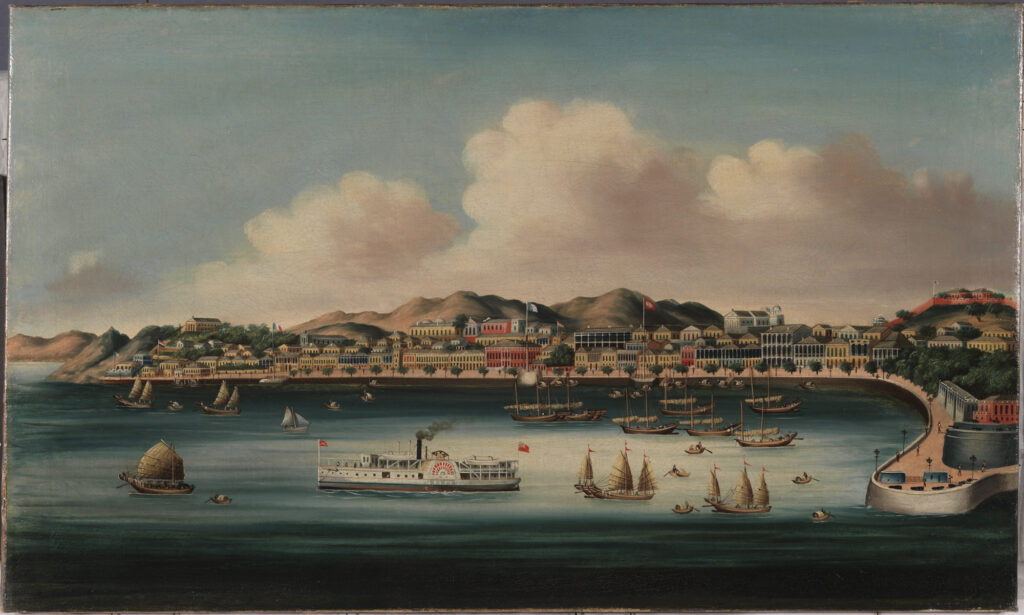
Artist Unknown (China Trade Painting), View of the Praya Grande, Macau,
mid 19th century
Collection of Fukuoka Asian Art Museum
China Dream
- Period
- Sep 23, 1999 〜 Nov 9, 1999
- Venue
Asia Gallery B
At the beginning of this century, shortly after the Republic of China was formed after a collapse of the Qing Dynasty, the biggest international trading city in the East had appeared in Shanghai. Modern art and modern culture such as movies and jazz music developed gradually in Shanghai, around the British and French settlement where stylish western buildings lined up and Shanghai Band where dignified buildings of foreign merchant offices and hotels stood.
Under those circumstances in the 1920’s and 30’s, posters advertising imported goods like tobacco and cosmetics, western insurance companies and trading companies became very popular in Shanghai. It was because coquettish women in the posters symbolized a modern life style which the general public dreamt of, dressed in fashionable clothing and surrounded by imported goods. These posters were, so to speak, something that reflected people’s adoration to the West. Furthermore, these were not mere posters but put to practical use with calendars to be sent out to customers at the beginning of the year as one of nen-ga (a year picture – a picture to wish for good luck of a year). These were called a poster with a calendar or a nen-ga with a calendar. Thus the posters announced the coming of the new era, the arrival of capitalism and the consumption culture to each city in China.
Incidentally, descendants of artists who made China trading paintings were also making the original pictures of the posters. Therefore, the representation method peculiar to China trading paintings (three-dimensional representation done by a technique harmonizing Chinese ink and Western watercolors) are taken over to the original pictures of the posters.
| Venue | Asia Gallery B |
|---|---|
| Admission | Adult: ¥200(¥150) High School/College: ¥150(¥100) Junior High School and Elementary: ¥100(¥60) |
| Organiser | Fukuoka Asian Art Museum |
