

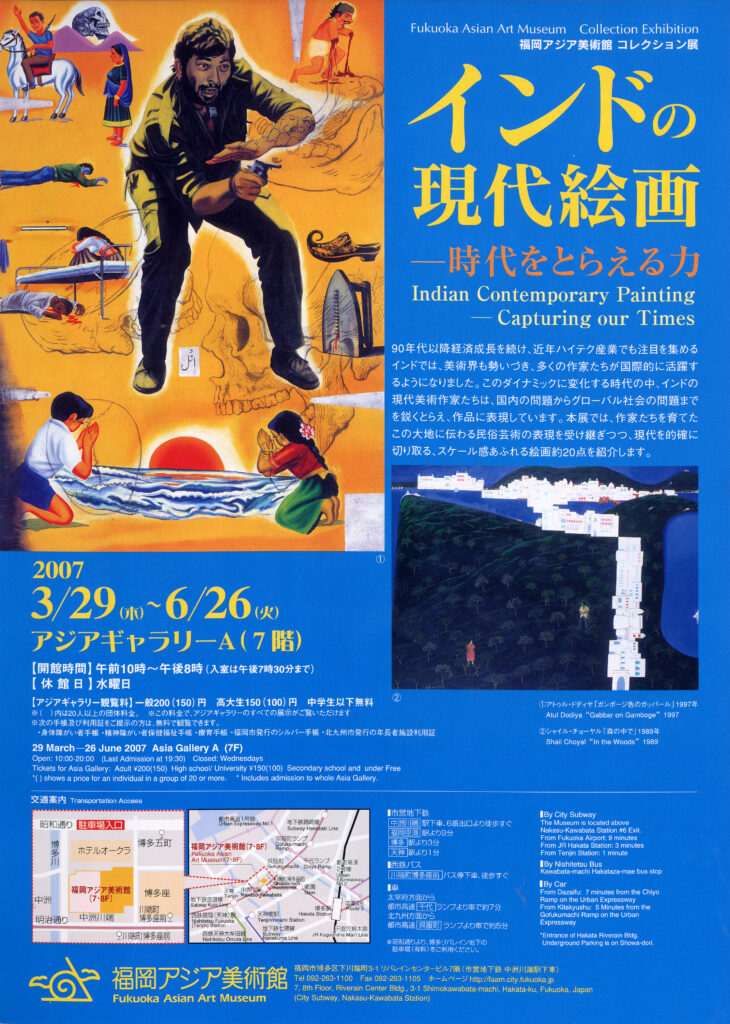
Indian Contemporary Painting
- Capturing our Times
- Period
- Mar 29, 2007 〜 Jun 26, 2007
- Venue
Asia Gallery A
The continuous economic growth of the 90s has led India to gain much recognition in fields such as IT industry. The country’s art scene is also building up momentum with an increasing number of Indian artists actively participating in international arena of contemporary art. Against this backdrop of dynamic social change, contemporary artists from India are capturing and expressing the local and global issues in their works.
The implementation of the government’s new economic policies in 1991 has led to economic liberalization, privatisation and deregulation in India, as a result, creating an average economic growth of 6% throughout the 90s. Along with this growth, the middle-class population who can afford to acquire artworks and the total number of art galleries have increased. Cities such as New Delhi—India’s capital, Mumbai—its economic hub, Bangalore—the Silicon Valley of India, Vadodara—where the most prestigious art school is located, Kolkata—where art museums and galleries concentrate, have all become the centers of Indian contemporary art. With numerous exhibitions of works by Indian artists being held domestically and international biennales/triennales almost always including Indian artists, the Indian art scene is gaining momentum.
At the same time, the rapid economic growth has also led to various serious social issues—a large number of workers immigrating to the cities, the widening gap of wealth between urban and rural areas, and the worsening environmental issues. Various forms of power relationship, such as caste-based discrimination, male-female divide and the negative legacy of the British colonial occupation, also continue to remain as well. Furthermore, the religious conflict between Hindu and Muslim in the country has increasingly intensified since 9.11.
Amidst such dynamic social change, artists are sincerely tackling to capture this era by using various approaches, such as forming a connection between their individual ideas with the current social situation, consciously keeping distance or shifting their standpoint to observe these issues. The artists have also utilized and given new life to various traditions which they have learned firsthand growing-up—the ancient religious rituals and festivals, a wide range of formative expression and the use of vivid colours rooted in popular and folk art.
16 works of Indian contemporary art mainly since the 90s are introduced in this exhibition. Carrying a distinctive sense of vastness, infused with the spirit of folk/popular art that has been handed for generations in the land, the works on exhibit sharply capture our times.
| Venue | Asia Gallery A |
|---|---|
| Admission | Adult: ¥200(¥150) High School/College: ¥150(¥100) Junior High School and Under: Free |
| Organiser | Fukuoka Asian Art Museum |
