

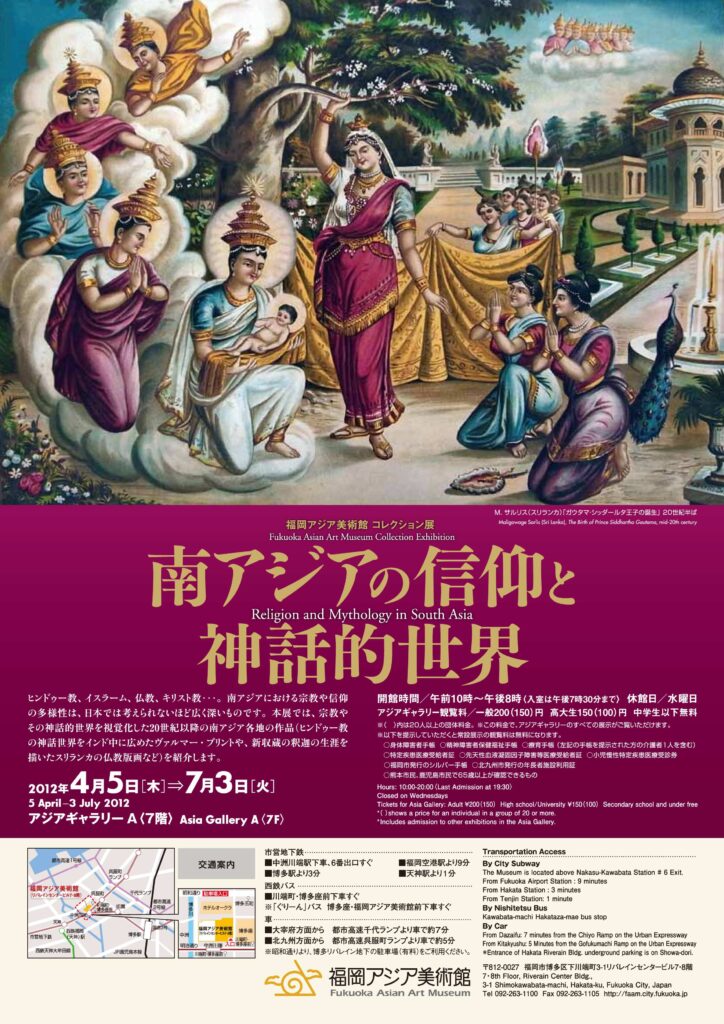
Religion and Mythology in South Asia
- Period
- Apr 5, 2012 〜 Jul 3, 2012
- Venue
Asia Gallery A
Hinduism, Islam, Buddhism, and Christianity are the major religions worshipped in South Asia, embracing a vast and deep context that is unimaginably large in scale compared to Japan. Primarily focused on those created during and after the 20th century, this exhibition features works from South Asia (such as Varma Print* from India and Buddhist Print Art** in Sri Lanka) that unfold the religions and their mythological visions of the region.
Hinduism
Based on Vedas of Brahmanism, Hinduism has been formed and developed, entangled with various folk believes and ethnic religions across India. As its caste system clearly shows, Hinduism goes beyond religion and is closely associated with people’s lives. In South Asia, there are more than eight hundred million Hindus in India, presumably but beside that, more than 80 percent of the total population in Nepal is of the Hindu faith.
This section of the exhibition introduces diverse works which show the pictorialized Hindu pantheon and its mythic world.
“Pauba Painting”
“Pauba” refers to religious painting created by the Newar People of Nepal, which deals with not only Hinduism but also Buddhism. In this section, the recent Pauba works which depict Hindu deities are exhibited. Udaya Charan Shresta has broken new ground in the field of Pauba painting with his works depicting a vigorous and coquettish deva.
Contrasted with those works, modern paintings created by Shashi Shah and Batsa Gopal Vaidya are also exhibited here. Utilizing clear colors and simplified form, both artists visualized the Hindu deities and pursued their unique figurative expression.
“Mithila Painting”
This traditional folk painting, which can be found in Madhubani of Bihar, India and part of Nepal, has been handed down mother to daughter at every door. Since the legendary “Mithila Kingdom” is said to have existed in this region, the painting is referred to as “Mithila painting.” The painting originally took the form of mural or floor painting yet has become painted on paper or cloth, which can be sold to raise funds for escaping from poverty or supporting the self-reliance of women.
“Kalighat School Painting”
After Kolkata (Calcutta) became the capital of British India, this style of painting was created and developed by scroll painters who moved from surrounding villages to the city. Since many of them gathered around Kalighat Kali Temple established in 1809, the painting is thus referred to as “Kalighat school painting.” Originally produced for local worshippers at the temple, the paintings were also purchased by the British in India as souvenirs at the time. The simplified lines, also commonly seen in Mithila style painting, left its mark on paintings of Indian modern art, such as the works of Jamini Roy.
“Varma Print”
In the late 19 century, Raja Ravi Varma, an Indian painter, visualized the legends and myths of the Hindu pantheon such as “Mahabharata” utilizing a Western realistic painting manner. He was held in high esteem by Rajas of India. He founded his own printing shop in 1892 and mass-produced lithographs out of his own “Varma” paintings and other works. This made his paintings, which were once unaffordable for most people, widely available all over India as a popular printed matter called “Varma Print”.
Islam
South Asia, particularly around Northern India became under the rule of Islamic dynasties after the 11th Century. Even today, Pakistan, Bangladesh, and the Maldives remain overwhelmingly Muslim societies; meanwhile India also counts more than 100 million Muslims, which make up 10 percent of the total population of India. Being the belief in Allah, the existence of one god, Islam practices outright rejection of idol-worship. Therefore it saw the development of calligraphy, architecture and miniature as a book illustration. Yet Islamic mythology has never been represented by the manner similar to Hinduism or Buddhism. This section exhibits illustrated calendars of Bangladesh from our FAAM collection.
“Calendars of Bangladesh”
Various images, such as politicians, film stars, and historical architecture appear on calendars in Bangladesh. “A praying figure” is common among religious subjects on the calendar. For Muslims, “Salat” or the ritual worship is one of five religious practices which form the basis of Islam. The practice of the worship is prescribed five times per day, in the direction of the Kaaba in Mecca.
Christianity
Due to the establishment of Portuguese hubs in Goa and Calicut, both in Southwest India during the Age of Exploration in the 16th century, the people with Christianity in South Asia, mostly Roman Catholics, are concentrated in this region. Alongside of Hindus and Muslims, the number of Christians is very low and not so many Christian art and architecture exist in this area. Even in such an environment, Western style paintings, and Christian art which can be stated as from the mainstream of Western art, have strongly influenced South Asian painters. Utilizing such images and style, Raja Ravi Varma brought a new perspective to Hindu mythology and Maligawage Sarlis of Sri Lanka also pictorialized the world of Buddhism. This section introduces works of Jamini Roy, who pursued his unique style of figurative expression based on Indian folk painting and of Nalini Jayasuriya, a Sri Lankan female artist.
Buddhism
Originally born in the Indian subcontinent in the 5th century B.C.E and flourishing during the era of King Ashoka, Buddhism has been losing its presence in South Asia as it has been overtaken by Hinduism and Islam. However, Buddhism is still widely spread, taking in various forms such as Theravada Buddhism in Sri Lanka and of Kagyu school of Tibetan Buddhism in Bhutan as well as in India and Nepal.
This section shows Sri Lankan Buddhist print arts (a newly acquired collection in 2011), Bhutanese Buddhist alter, and the Pauba paintings of Nepal.
“Choshom (Buddhist Altar, Bhutan)”
The pieces are Buddhist print arts created by Maligawage Sarlis, a painter who played a significant role in the history of Sri Lankan modern art. The artist produced paintings and scriptures for Buddhist temples in the early 20th century. The images of those paintings were later reproduced with lithographic printing in Germany and got into circulation across Sri Lanka. The series of his works depicting the life of Buddha and Jataka tales is exhibited in this section.
“Choshom (Buddhist Altar, Bhutan)”
Buddhist arts, including “Thangka” or Tibetan style Buddhist painting, have been cradling Buddhism and carefully preserved in Bhutan. A Buddhist alter is one of these Buddhist arts. This is a typical Buddhist altar used in Bhutanese households, created by Karma, a wood carver and Leki Dorji, a painter. Consisting of alter parts called Choshom (upper part) and shelf part called Bangdom (lower part), the alter houses 12 Buddha statues and two stupas.
“Pauba Paintings”
Pauba paintings depicting various deities of Buddhism are exhibited here.
| Venue | Asia Gallery A |
|---|---|
| Admission | Adult: ¥200(¥150) High School/College: ¥150(¥100) Junior High School and Under: Free |
| Organiser | Fukuoka Asian Art Museum |
| Contact | Fukuoka Asian Art Museum |
